The Billable Hour Is a Pyramid Scheme for Your Sanity
Why the very metric we use to measure success is the one that guarantees institutional rot.
Every law firm I've ever worked in treats the billable hour as a fact of nature, like gravity, or partner ego. It is neither.
The billable hour is a specific historical accident, popularized in the late 1950s to solve a specific problem: how do you price something no one can weigh? The answer, it turned out, was to charge for the appearance of effort rather than the effect of the work. Seven decades later, we are still doing it, and the industry it built is now eating its own young.
Here is the quiet math no one wants to run out loud. If an associate is expected to bill 1,900 hours a year, they need to work closer to 2,600 to hit that number, once you account for pitches, admin, training, and the six minutes here and eleven minutes there that no client will pay for. That gap, the 700 uncompensated hours, is the tax we levy on being competent.
The firms that will survive the next decade are the ones that have already noticed this. The rest will discover, one associate exit interview at a time, that they were never selling law. They were selling a clock.
The billable hour is not just a pricing model that happens to be hard on people. It is a pyramid scheme. It charges the people at the bottom an entry fee in time and health, pays returns upward, and penalizes every attempt to get better at the work. A firm that only counts hours will slowly stop building anything that isn't an hour.
The 700-hour tax on being competent.
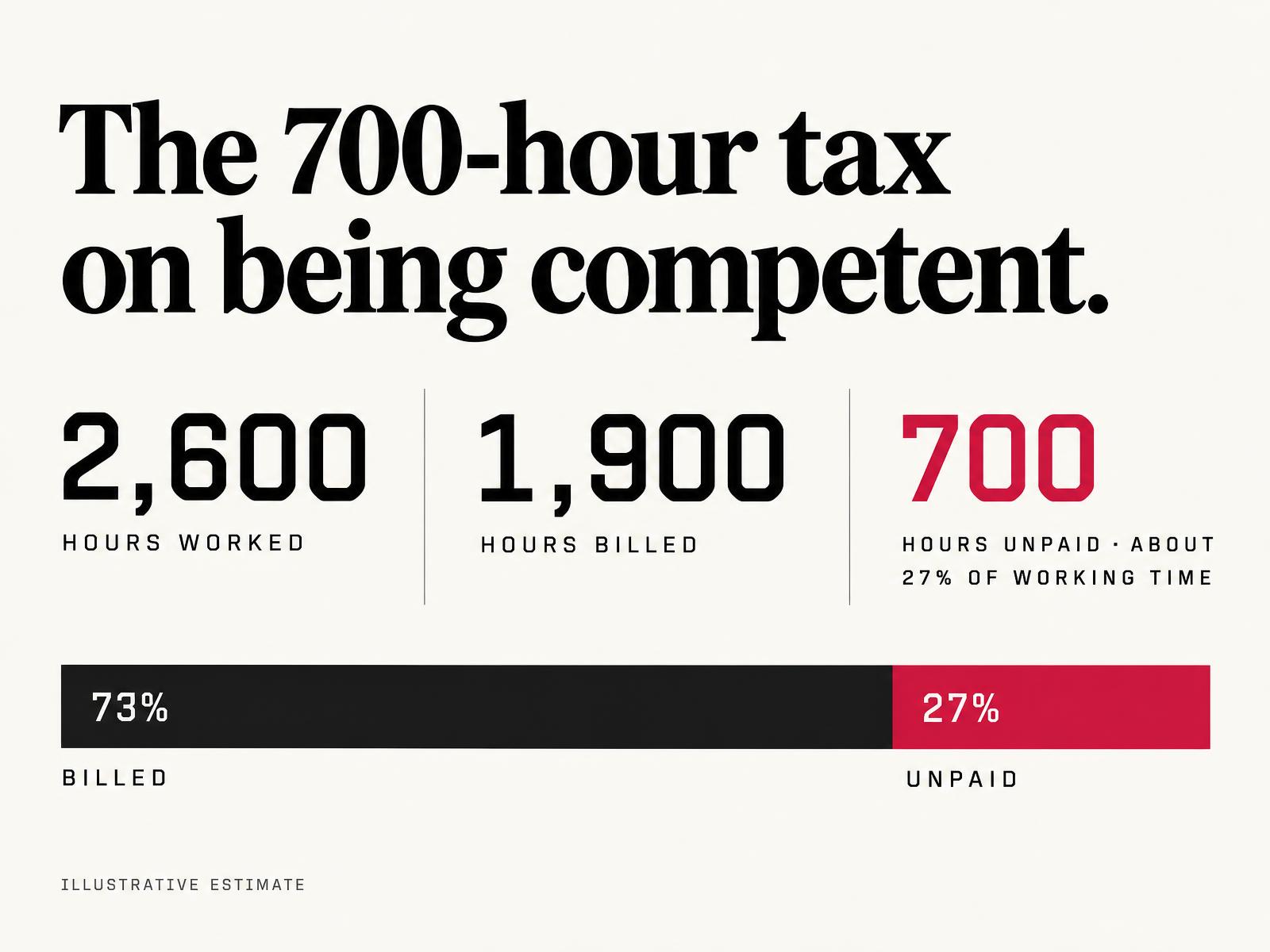
- 2,600 hours worked
- 1,900 hours billed
- 700 hours unpaid, about 27% of working time
More than a quarter of an associate's working year is invisible to the metric.
Illustrative, based on typical targets and non-billable estimates.
Why the hour deserves its reputation
Start with what the billable hour gets right, because it gets a lot right.
It is simple. Everyone understands it, from the first-year to the client's procurement team. You can audit it line by line.
It is fair to both sides when the work is uncertain. Nobody knows how long a contested deal or a hostile litigation will take. Billing by time shares that uncertainty between firm and client instead of loading it all onto one side.
And it survived. Alternative fee arrangements have been promoted for decades, and hourly billing still dominates. Markets do not usually keep a model for seventy years by accident.
All of that is true. But notice what every one of those arguments is about: sending an invoice. None of them is about running a firm. That is where the trouble starts.
Anatomy of the scheme
"Pyramid scheme" is a structural claim, not a legal one. Nobody is committing fraud. But compare the mechanics, one by one.
- An entry fee at the bottom. New associates pay in hours they will never be paid for: the 700-hour gap, every year, plus evenings, weekends and sleep.
- Returns flow upward. The surplus between what associates bill and what they are paid funds the layer above them, and then the layer above that. That is the leverage model doing exactly what it was designed to do.
- A promised payout for a few. The reward that justifies the entry fee, partnership, goes to a small share of those who pay in.
- Constant recruitment. The base burns out and leaves, so the firm must recruit a fresh class every year to keep the structure standing.
- Collapse when the base shrinks. The scheme only works while there is enough junior work to sell by the hour. Remove that work and the returns at the top go with it.
Paid in at the bottom, collected at the top.
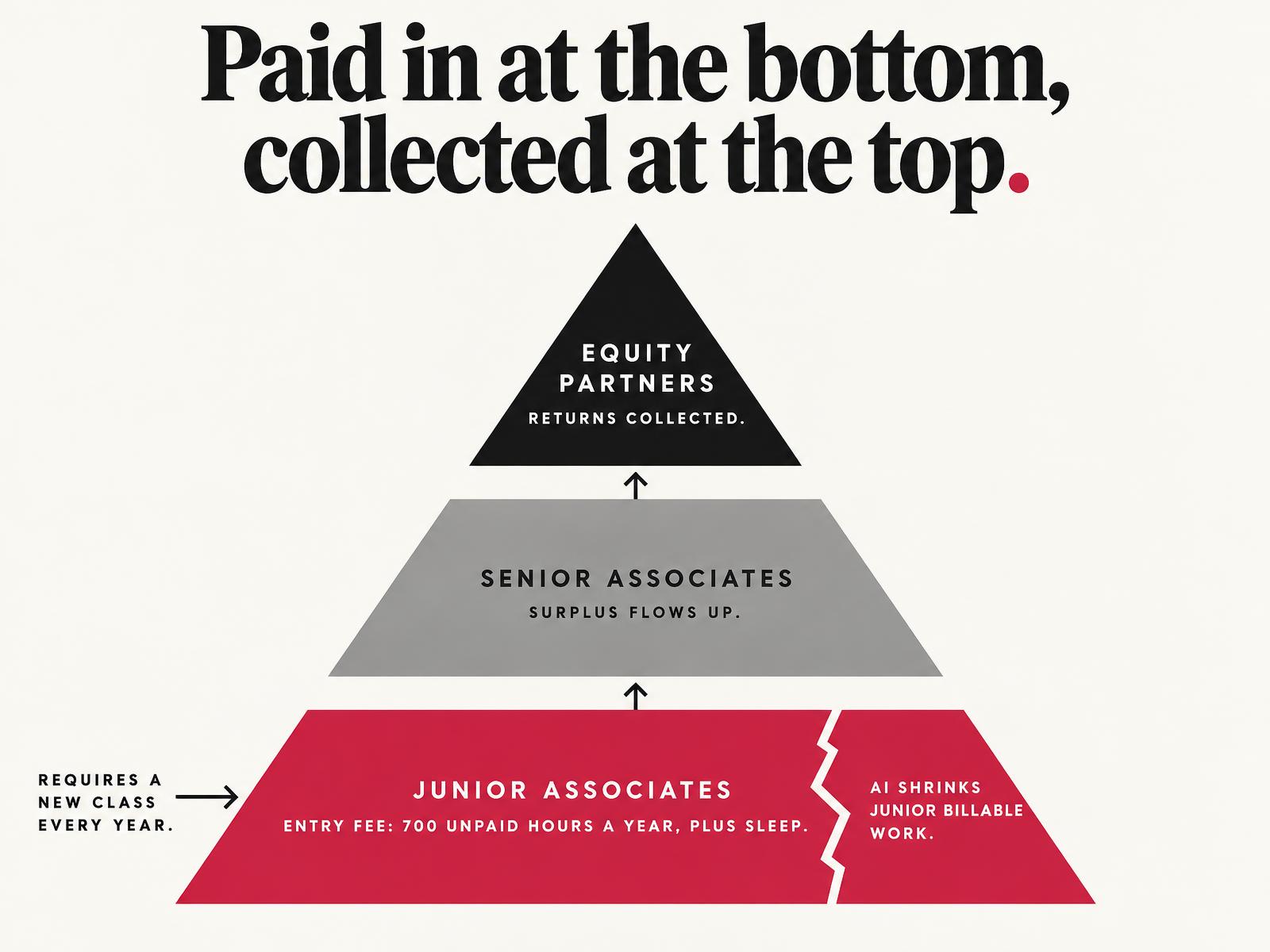
- Equity partners: Returns collected.
- Senior associates: Surplus flows up.
- Junior associates: Entry fee: 700 unpaid hours a year, plus sleep.
- Requires a new class every year.
- AI shrinks junior billable work.
The structure depends on a base that is starting to shrink.
REBEL/LAWYER analysis.
Now think about which of those five has just started to change. It is the fifth one. That is why this conversation is urgent now, not in another decade.
The metric that punishes getting better
Here is the mechanism that does the real damage. It is an illustrative model, not data from any firm.
An associate drafts a set of transaction documents. It takes 10 hours. At an $800 rate, the firm bills $8,000.
Next year, she builds a better precedent, or uses a well-configured AI tool, and the same work takes 4 hours. The client gets the same documents, faster.
Look at what the firm's numbers record:
- Revenue: $8,000 drops to $3,200.
- The associate's "productivity": down 60%, because productivity means hours.
- The partner's book: smaller, which shows up at the next compensation committee.
The client got better service. The firm recorded a $4,800 loss. The associate looks less productive for having improved.
The client wins. The timesheet loses.
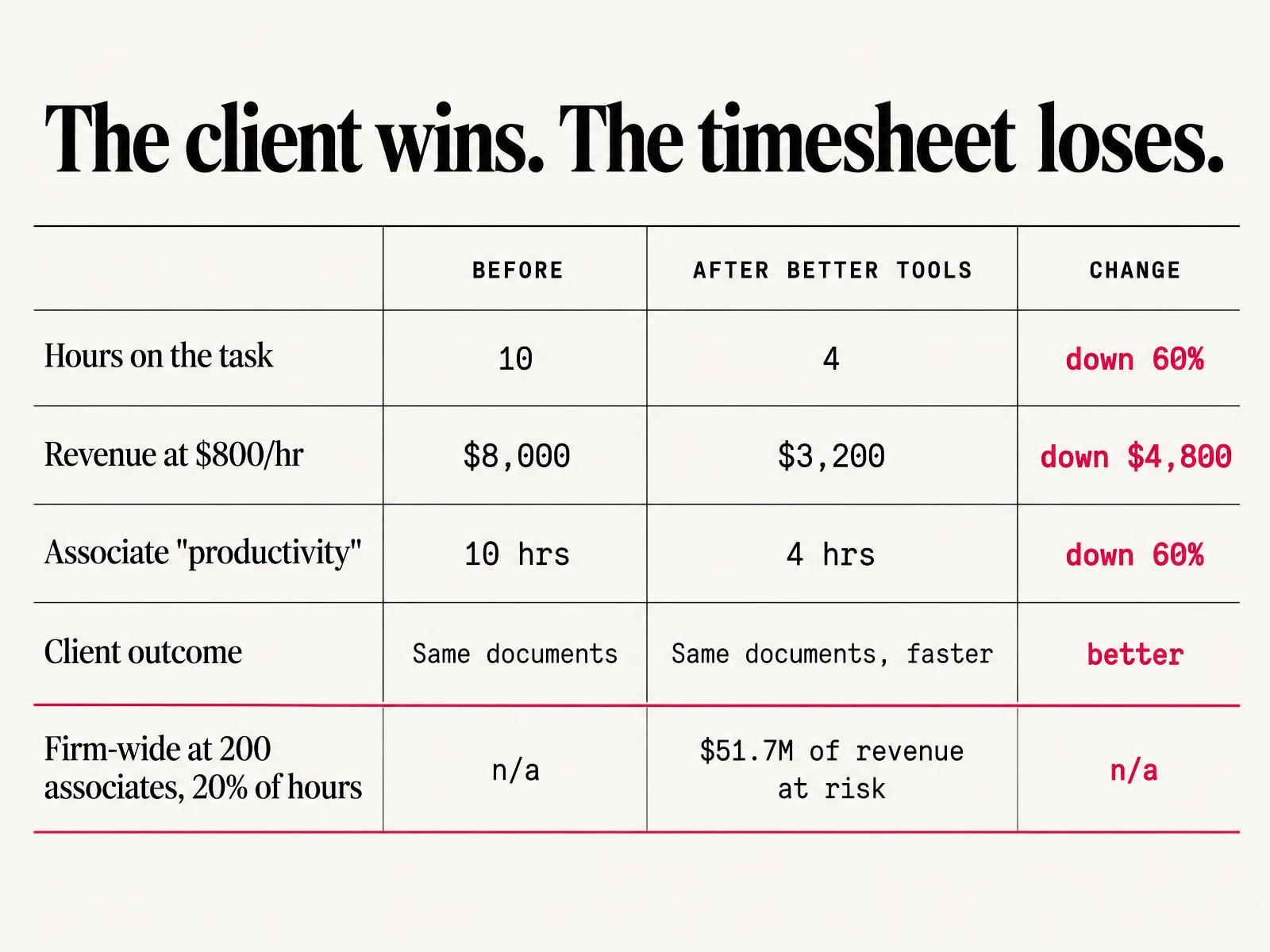
| Measure | Before | After better tools | Change |
|---|---|---|---|
| Hours on the task | 10 | 4 | down 60% |
| Revenue at $800/hr | $8,000 | $3,200 | down $4,800 |
| Associate "productivity" | 10 hrs | 4 hrs | down 60% |
| Client outcome | Same documents | Same documents, faster | better |
| Firm-wide at 200 associates, 20% of hours | n/a | $51.7M of revenue at risk | n/a |
Under the hour, improvement is recorded as a loss.
Illustrative model. Not data from any firm.
Scale it up. Take a firm with 200 associates, each billing 1,900 hours. Suppose 20% of those hours involve tasks that better tools could compress sharply. Some estimates put the share of legal tasks exposed to automation well above that.
That is 76,000 hours a year. At $800 an hour and 85% collection, it is about $51.7 million of revenue that depends on the firm staying slow.
So the rational firm does something irrational. It buys the tools, announces an innovation strategy, and then quietly makes sure nobody uses them enough to dent the hours.
What an engineer and a strategist would see
Two outside lenses explain why smart people keep running this system.
Lens one: Goodhart's law.
The economist Charles Goodhart observed that a measure tends to stop working once people are pushed to hit it as a target.
Hours began as a reasonable proxy for effort and value. Then firms made them the target: for bonuses, for reviews, for partnership. Once that happened, the number started measuring itself. People padded time, protected inefficient processes and avoided anything unbillable, because the scoreboard told them to.
An engineer would recognize this immediately. You have tuned the whole machine to a gauge that no longer reads the thing you care about.
Lens two: the innovator's dilemma.
Clayton Christensen showed how successful companies fail. They are not lazy or stupid. The new technology threatens their most profitable existing business, so every rational short-term decision says "not yet."
Law firms are the textbook case. Every efficiency gain cannibalizes billable revenue. Every partner who adopts faster methods shrinks his own numbers. The firm is not resisting change out of fear. It is resisting change because its own metric tells it to.
Meanwhile, a competitor without that metric can price the same work at a fixed fee and keep the efficiency as margin. That competitor might be an alternative legal provider, a tech-enabled boutique, or a client's in-house team.
What the hour won't pay for
Here is where "institutional rot" stops being a slogan.
Make a list of the things that keep a firm healthy over decades:
- Training juniors properly.
- Building precedents and knowledge systems.
- Mentoring and honest feedback.
- Improving processes.
- Thinking about a client's business before they ask.
None of them is billable. Every one of them comes out of the 700-hour gap, or doesn't happen.
The billable hour doesn't just fail to reward the work that sustains a firm. It actively charges people for doing it. Every hour spent mentoring is an hour you must make up at midnight.
Then look at the human ledger. Large studies of lawyers have reported high rates of depression, anxiety and problem drinking, well above the general population. Not all of that is the hour's fault. But a system that charges an unpaid tax of 700 hours a year is not neutral on sanity. It is where sanity gets spent.
The objection: clients want hours
The strongest objection deserves a fair answer.
"Clients ask for hourly billing. It gives them transparency and control. Fixed fees push risk onto the firm and invite corner-cutting. The hour survived because it works."
Concede the important part. For genuinely uncertain work, billing by time is a reasonable way to share risk. Some clients prefer it, and fixed fees can be priced badly.
But that objection is about pricing, and the rot comes from management. A firm can bill clients by the hour and still refuse to run its people by the hour. Those are two separate decisions that firms have fused into one.
You can invoice in six-minute units and still reward the associate who cut a task from 10 hours to 4. You can keep time records and still give real compensation weight to training, knowledge and outcomes.
Nothing in the engagement letter prevents it. Only habit does.
The reframe
When the only thing you count is time, the only thing you build is a clock.
The billable hour is a fine way to send an invoice and a terrible way to run a firm. Keep the invoice if your clients want it. Stop letting it decide who you promote, what you build and how your people sleep.
What a rebel does on Monday
- If you're an associate: track your non-billable hours for 30 days in four categories: admin, training, business development and unbilled client work. At your next review, say it plainly: "I worked roughly 2,600 hours to bill 1,900. Here is what the other 700 built."
- When you find a faster way: write a three-line note to your supervising partner. Say what you changed, how many hours it saved and what the client gained. Make the efficiency visible before the timesheet makes it look like a shortfall.
- If you're a partner: on one matter this quarter, offer a fixed or capped fee. Measure margin, not hours, and share the result at a partners' meeting.
- If you sit on management: add one non-hours measure to every review with real compensation weight. Use something like knowledge contributions, matters delivered under budget or juniors trained. Give approved innovation and training time billable-hour credit.
- If you're a general counsel: ask each panel firm one question. "What efficiency gains from technology have you passed on to us this year, in dollars?" The silence will tell you whose interests the hour serves.
The close
Go back to the first line. A fact of nature, like gravity.
Gravity doesn't care how good you are at your job. The billable hour does, and it punishes you for it. It charges you for mentoring and docks you for getting faster. Then it calls the result productivity.
The firms that last will keep the clock on the invoice, where it belongs. The rest will keep winding it until there is no one left at the bottom to pay in.
They were never selling law. They were selling a clock.
The Diagnostic
If you read the 700-hour line and did the math on your own year, you already know what this essay is about. The Diagnostic measures how dependent your firm or your practice is on the hour. It covers unbilled time, efficiency penalties and what your metrics actually reward. It takes fifteen minutes and gives you a number you can bring to your next review.
Take the diagnostic